Operational work on deck
Mooring, cargo-support, lookout, maintenance and safety duties can form part of the route. Certification and sea-service requirements depend on the administration and role.
Choose one job lane and one maritime administration before paying for a course. Compare official requirements, build the document chain in the right order and apply only through verified employers or regulated services.
Mooring, cargo-support, lookout, maintenance and safety duties can form part of the route. Certification and sea-service requirements depend on the administration and role.
Engine-room watches, maintenance support, tools, housekeeping and safe systems of work. Technical evidence helps, but it does not replace required training or certification.
A sponsored or approved program can combine college study, onboard training, recorded sea service and examinations toward a certificate of competency.
Passenger, galley and accommodation roles use hospitality evidence but may still require medical, safety, security and ship-specific documentation.
Write down one target department, capacity and vessel type. Then identify the maritime administration responsible for issuing or recognising the required certificate.
Record age, identity, work-right, medical, approved training, examination and qualifying sea-service requirements. Do not combine checklists from different countries.
Use employer or sponsor career sites. Capture the actual role, flag, location, contract, rotation, certificate, experience and application route. Separate mandatory requirements from preferences.
Check the exact course, site and approval with the relevant administration. Ask whether the route supplies sea time or expects you to obtain it separately before paying.
Show relevant safety habits, teamwork, maintenance, watchkeeping, hospitality or technical evidence without claiming certificates or sea service you do not hold.
Apply through official channels, keep copies and review responses before changing route or purchasing more training. Rejection alone does not identify the missing credential.
| Source | Evidence visible now | Practical limit |
|---|---|---|
| International Maritime Organization | STCW sets international minimum standards for seafarer training, certification and watchkeeping. | Countries implement and may exceed those standards; “STCW certified” is not one universal job entitlement. |
| UK Maritime and Coastguard Agency | UK routes can require minimum age, medical fitness, training, sea experience, certificates of competency and a discharge book. | Use the exact UK rating or officer guidance; this page is not a certificate checklist for another flag. |
| U.S. Coast Guard National Maritime Center | U.S. merchant-mariner routes use credential, medical, safety-and-suitability and role-specific application checks. | U.S. forms and endorsements do not automatically describe UK, Australian or Canadian entry. |
| Australian Maritime Safety Authority | Australian STCW certificates can require an AMSA medical, approved training, qualifying sea service and, for officers, assessment and an oral exam. | Requirements differ by certificate; overseas certificates may need recognition. |
| Transport Canada | Canadian certification links training, experience, examinations and a discharge book; certificate issuance also has status requirements. | Confirm the exact Canadian certificate and eligibility before committing to a school. |
For suspicious remote recruiting messages, use Miando's free job scam checker without pasting private information.
Select one lane and administration. Map every current eligibility, medical, training, document and sea-time gate.
Capture ten official vacancies or sponsored programs. Verify providers and list the repeated requirements.
Build one honest CV and prepare examples for safety, teamwork, technical discipline or onboard service.
Submit five matched applications through official channels and review the evidence before the next decision.
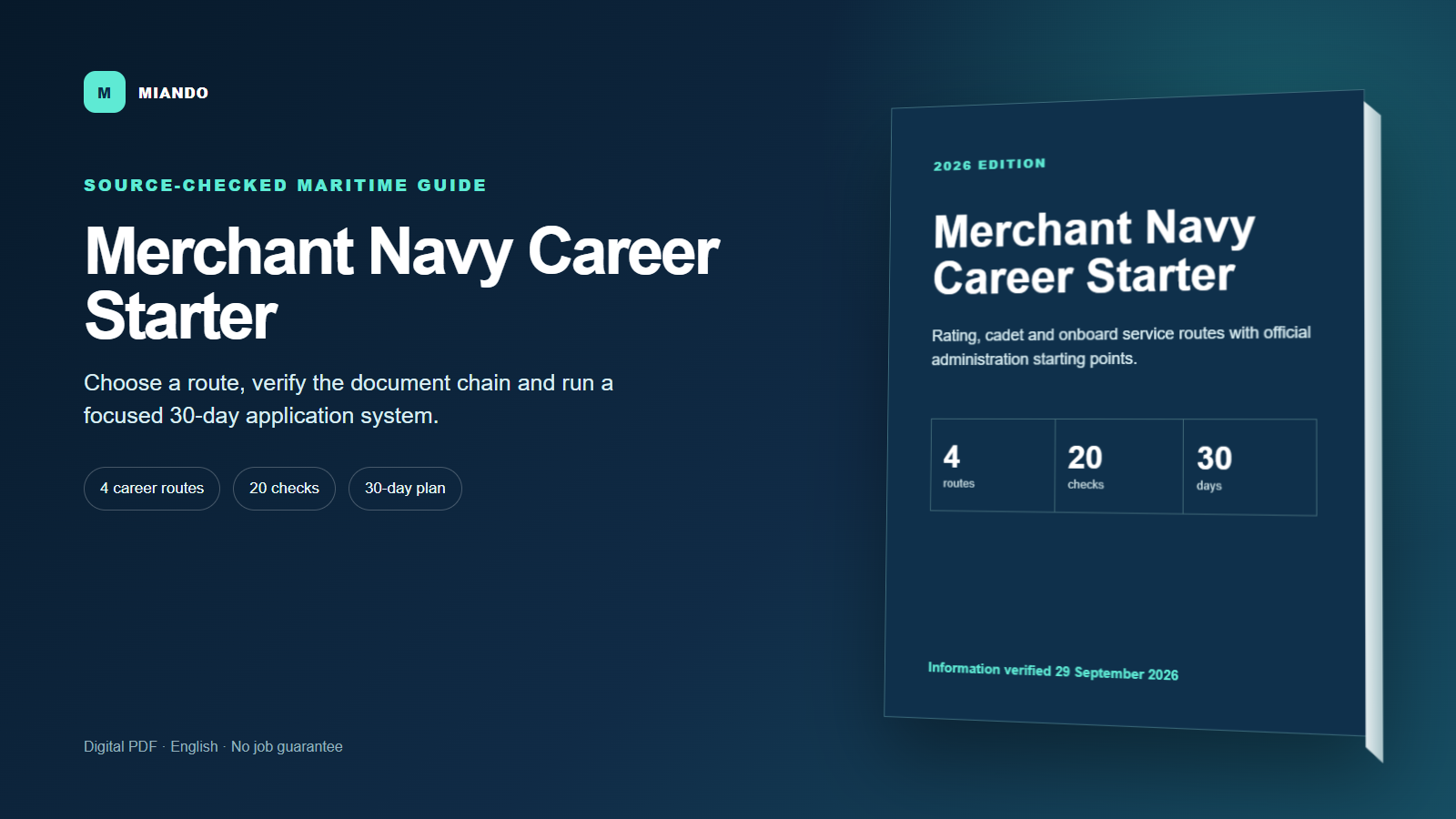
Use the free Excel tracker for 30 official vacancies and 50 applications. The prepared 16-page Merchant Navy Career Starter adds four route maps, 20 pre-application checks, national starting points, an application plan and a recruitment-fee guard. Checkout is not active; you can review the scope and cast an anonymous launch vote.
Download the free Excel tracker Review the career starter and voteIt depends on the route, administration, flag, vessel and employer. Identify the exact role and use the responsible maritime administration's current requirements before buying training.
Ratings perform skilled operational and support duties in departments such as deck or engine. Officer cadets follow a structured education, onboard training and certification route toward an officer certificate of competency.
Some entry or sponsored routes are designed for new entrants, while other roles require qualifying sea service. The live program or certificate route controls. Verify how required sea time is obtained before paying.
The Maritime Labour Convention protects access to recruitment without charge, subject to limited personal-document exceptions. Independently verify the recruiter, employer and applicable national rules before paying anything.
No. It does not guarantee employment, sponsorship, a berth, sea time, medical fitness, work authorization, certificate issuance or recognition.
Editorial rule: Vacancies, medical standards, approved providers, certificate routes, immigration rules and recognition arrangements change. Re-check the exact live source before applying, paying or representing a qualification.